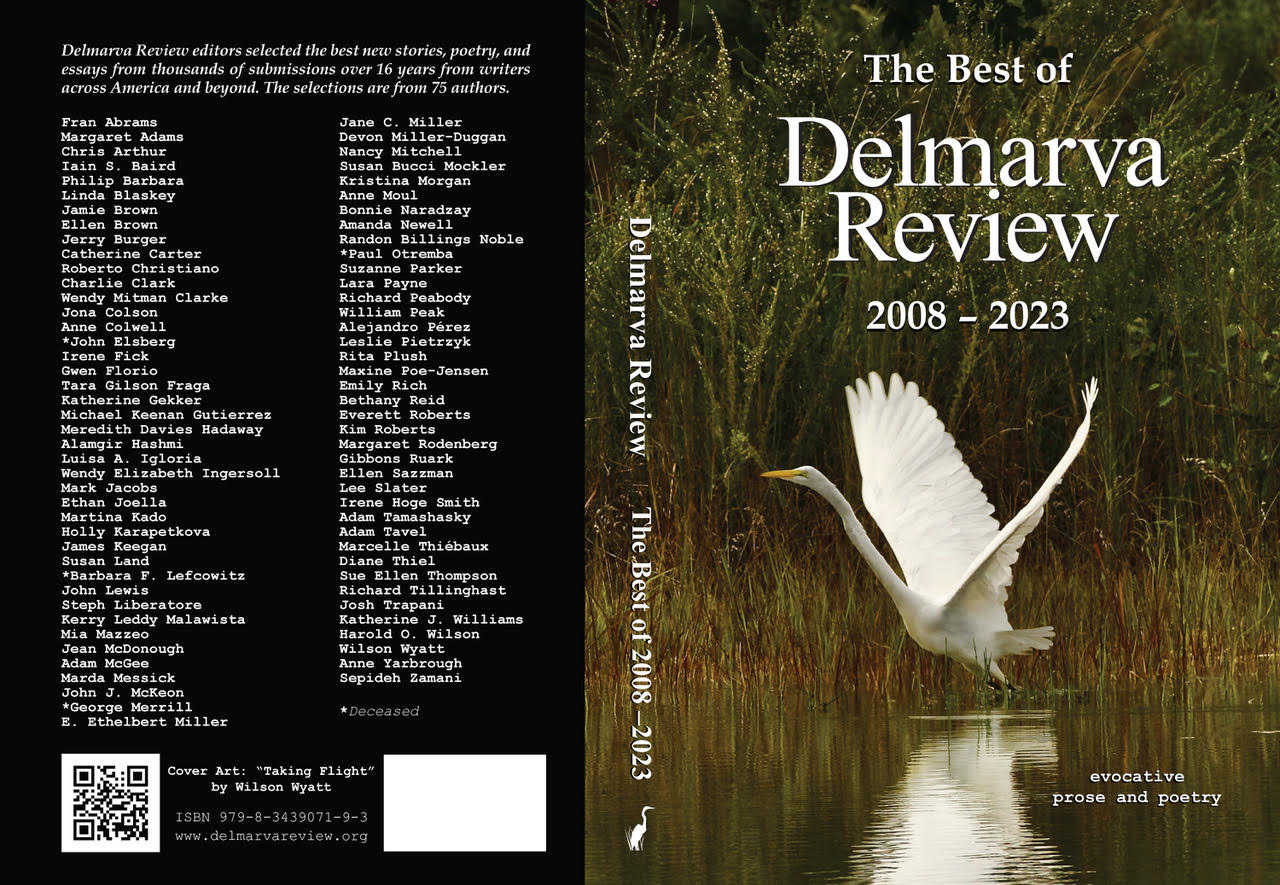
Delmarva Review Anthology

The Delmarva Review has released their first anthology, a beautiful book spanning the best of sixteen years of publications. Included are two of my prose pieces: “Nursing 101,” creative nonfiction from Volume 4 (2011), and “Undertow,” a short story from Volume 6 (2013). I am so pleased to be one of the seventy-five authors selected, and the only author represented in both the nonfiction and fiction sections.

The Delmarva Review was my first literary magazine acceptance. They published my work three times while I was a nursing student in Baltimore, and I cannot overstate how supportive they were of both the work they published and of me as a writer. I learned so much just going over edits with the team. Twice they invited me to read at the Writer’s Center. I drove my battered car—the Toyota I later sold to the autobody shop to cover my outstanding repair bills—to Bethesda, and at the end of my first reading, they let me take home the extra cheese plate. I made fancy pepper jack omelettes for my classmates. I remember exactly where I was when I opened my email to find out they’d nominated me for a Pushcart Prize. Twice, they interviewed me for Writer’s Edition on Delmarva Public Radio.

On a very concrete, editorial level, The Delmarva Review helped me become a much better writer. But they also introduced me to the idea of literary community and taught me what that looked like.

All of which is to say: I am deeply grateful. Support literary magazines in general, and the Delmarva Review in particular. Buy a copy of this anthology. I’m proud to be included.

Protocol for What to Do After Hearing Another Rape Story in Exam Room Five

Many thanks to Morgan Talty for choosing my flash fiction story, “Protocol for What to Do After Hearing Another Rape Story in Exam Room Five,” for the Fractured Lit Anthology 4 Contest. 

The story comes out twice: online today, and in a print anthology which will be published next spring.

It’s always gratifying to be published but it’s especially thrilling to know that one of your writing heroes has read and selected your work. Morgan Talty’s short story collection, Night of the Living Rez, wrecked me so thoroughly, I can remember exactly where I was (in my parents’ house in Maine) when I finished the last story. I can’t wait to read his debut novel, just out with Tin House.

I drafted “Protocol for What to Do After Hearing Another Rape Story in Exam Room Five” about one year into my first job as a family nurse practitioner. I had awkwardly tried to ask one of my mentors whether or not there was a list of things I should be doing when people shared great traumas with me. I was very new to primary care and was routinely horrified at my own position of authority, and was hoping that medicine, a field which adores algorithms, might have a flowchart for me. My mentor did that thing where you ask for a resource and they reply, what a great idea, why don’t you make one. It was yet another moment of me realizing that medicine was not magic and the guidance I was looking for, if it existed, was not readily available. I also started writing a tongue-in-cheek protocol. The story didn’t grow legs until after I revised it several times over several years, finally leaning into the surreal. Which, on further reflection, is sort of closer to what most medical providers are taught to do: oh, you’re exposed to trauma? Have you tried leaving your body?

Thanks, Fractured Lit. Thanks, Morgan Talty.

Table Talk in Threepenny Review

I have a short essay published in the Table Talk section of Threepenny Review, Issue 158. You can purchase a copy online here.

A year ago I found a published collection of Threepenny‘s Table Talk essays and read them cover to cover. It’s such an honor to have my own Table Talk essay published now by such an amazing literary magazine.

My short essay – “We are your doctors, and this is the aftermath of idealism” – is about burnout and my frustrations with the U.S. healthcare system. It is a story of working in primary care, but it is not the story of working in primary care.

Wendy Lesser sent me a card and I danced in the post office with fangirl happiness:

threepennyreview

Understanding Book Use and Its Impact on You

My story “Understanding Book Use and Its Impact on You” has been published in Flash Fiction Magazine.

dangerous books

I drafted this story during a slow shift at an urgent care, in which I alternated between reading the clinic’s drug treatment pamphlets and compulsively checking the hold queue on my online public library account between patients.

You should know that I screen BAST-10 positive.

You can read the story online here.

“Doreen” in Joyland

My short fiction story “Doreen” is out in Joyland Magazine and can now be read in full on their website.

As The Seattle Review of Books wrote after last month’s Lit Crawl, “Joyland Magazine is built on a contradiction that isn’t one: that fiction is both an international movement and grounded in local communities. They have editors throughout the United States and Canada who are responsible for curating stories that define each region’s unique character, and they publish by the map — stories are grouped and tagged by location, so readers get to know the flavor of a particular place.”

From the same review: “Adams’ ‘Doreen’ (coming next issue) takes a woman comfortably padded against unpleasantness into the teeth of the medical system.”

Thanks to Joyland PNW editor Kait Heacock for picking “Doreen” out of the pile and giving it a home.

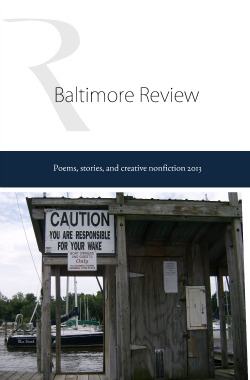
The Baltimore Review

BookCover-2013-Front_sm

The summer issue of The Baltimore Review just came out, including my story “Burnt,” a short (short) piece of creative nonfiction about the rowhouse across from us on Portugal street whose untimely demise coincided with one of our first weekends away.

The Baltimore Review was founded by Barbara Westwood Diehl in 1996 as a literary journal publishing short stories and poems, with a mission to showcase the best writing from the Baltimore area and beyond. Since its founding, the journal has grown to become a nationally distributed publication, and in 2004, an independent nonprofit organization. Susan Muaddi Darraj led the journal from 2003 to 2010, expanding contributions to include creative nonfiction and interviews; in 2011, Diehl resumed leadership of the journal, overseeing its 2012 transformation into a quarterly, online literary publication.

It’s an honor to be included in a home-turf publication that showcases so many great writers! I especially like the way the online format includes audio and image as well as text.